


You finished your short story or your poem. You’re planning to send it to literary magazines (our magazine, maybe? :)). Before you hit that send button, make sure your piece is properly formatted.
As a new writer, perhaps you don’t see the importance of formatting, but it is crucial. Take my word for it, or don’t :). But you should take the word of one of the industry’s gatekeepers. Literary agent Noah Lukeman, in his book The First Five Pages, mentioned many reasons a manuscript might end up in the trash bin before being read. You guessed it: poor presentation is the main one.
“It’s inevitably the presentation that is looked at before all else in a manuscript, that can signal unprofessionalism to an agent or editor.”
(The First Five Pages, Noah Lukeman)
So, what will happen if you don’t follow the standard manuscript format? After all, it’s the story that matters.
Yes, maybe for you. But:
- It’s an added cost to the publisher you’ve approached.
- It’s extra work for the exhausted editor or agent who has to go through a pile of stories that is higher than their more exciting TBR.
- It indicates that you didn’t read the submission guidelines, or you can’t follow directions. Which might suggest you’re a difficult person to work with.
Unlike with published or established authors, agents and publishers read your work looking for a reason to reject it. Don’t give them one.
“It is a shame that small—and easily preventable—surface errors can be determinants for an entire book, can prematurely prevent you from being taken seriously. On the other hand, these smaller signs may be indicative of a certain broader sensitivity: they may signal a carelessness, sloppiness, ignorance or defiance of the industry’s standards; that the writer doesn’t care enough to do the minimum amount of research to make a manuscript industry presentable. Often when a writer’s presentation is careless, his writing is too.”
(The First Five Pages, Noah Lukeman)
Don’t be that writer.
Sticking to industry standards will:
- Make your story look professional.
- Make it easy to read.
- Prevent poor presentation from working against it.
But first, if the magazine or the publisher you’re approaching has specific preferences, make sure you adjust your formatting accordingly. If no specifications are mentioned, then format your story following industry standards:
- A short story doesn’t require a separate title page (unlike a novel manuscript).
- Don’t include a header on the first page of your story.
- On the upper left corner of the first page, include your real name, email address, and other contact information.
- On the upper right corner of the first page, include the approximate word count.
- Center the title of your story about a third of the way down the page with the byline underneath it (your name, or pen name, preceded by by).
- Begin the body of your story a few lines below the byline.
- In the header, on the top right corner of each page, include your last name/story title/page number (separated by a slash (/)).
- The margins on all sides of the document should be set to 2.5 cm (1 inch).
- The text should be aligned to the left, not justified. Leave the right side ragged.
- The font should be 12-point Times New Roman.
- The text should be in black on a white background.
- The text should be double-spaced.
- The first line of each paragraph should be indented by 1.25 cm (0.5 inches).
- Don’t add additional spaces between paragraphs (including dialogue).
- The space after a period, or any other punctuation mark, should be single-spaced.
- Insert scene breaks instead of skipping lines with the Enter key when your story has a jump in time or location. Add a typographical symbol like a hash mark (#) or three asterisks (***) in the center of the blank line.
- Never underline text in your manuscript. Instead, use italics when needed.
- You don’t need an end marker, but you may center “END” a couple of lines below the final sentence to make it clear that no pages are missing.
There you have it. Now, if your story still gets rejected, it’s surely because of your bad writing. Haha, kidding!
Seriously, though, if you get rejected, it wouldn’t be because of the formatting. It could be that your piece didn’t speak to them, which is something beyond your control. It’s totally fine. You can’t expect everyone to like your writing.
But if your writing needs improvement, you can learn—you should learn. Writing is an art and a craft.
“The art of writing cannot be taught, but the craft of writing can.”
(The First Five Pages, Noah Lukeman)
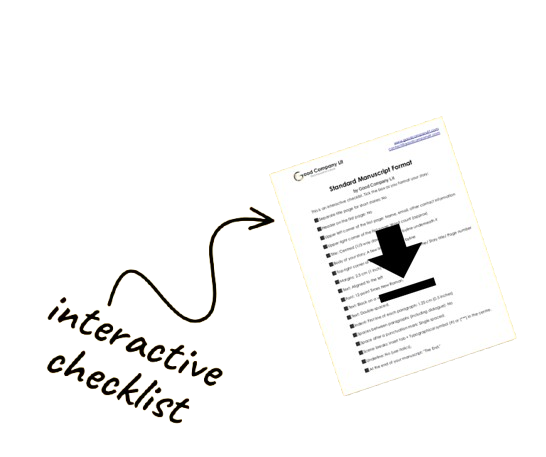
Now, to make sure you don’t forget anything while formatting, we’re offering a free interactive checklist where you can check the boxes as you go.
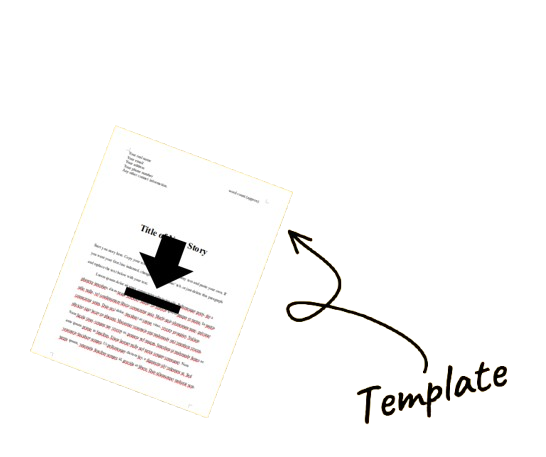
Also, here is a template you can use. Open it with Google Docs or Word and edit it to your liking. You can copy and paste your story into the body of the template. It will be formatted automatically.
Click on the link and grab these free resources now! Said Link 🙂
